




How to Choose the Best Barber Comb: A Barber’s Perspective
My name’s Dean,
and I’m a second-generation barber from Galveston, Texas. If you’ve ever spent time in Galveston, you know it’s a city with a long memory — hurricanes have swept through here more times than I can count, the most devastating being the 1900 storm that reshaped this island forever.
But Galveston rebuilt, and families like mine carried on their trades through good times and bad. For us, that trade was barbering.
My father started cutting hair in the late 1960s, right after Hurricane Carla (1961) had torn through the Gulf Coast.
He always said barbering was more than just a job — it was about giving men and women a sense of dignity, even when life felt unpredictable.
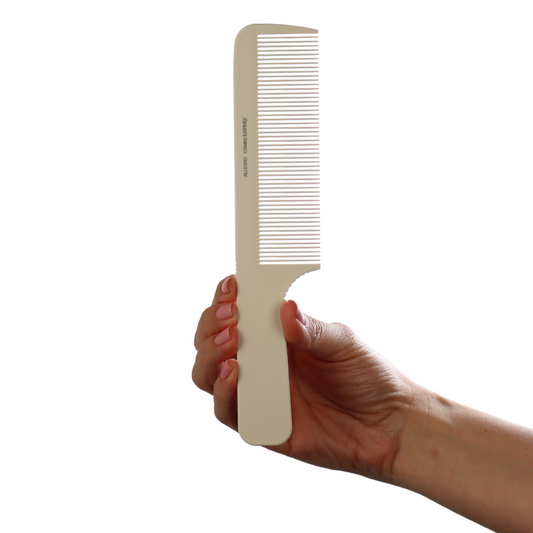
And one of the first tools he ever placed in my hand was a model #400.

Why the Comb Matters More Than You Think
A lot of people think a comb is just a comb. But when you’ve been behind the chair for decades, you realize that the right comb is as important as your scissors or clippers.
It controls the cut, guides your lines, and gives you the confidence to create styles that last.
My father used to joke: “A bad comb will betray you quicker than a bad clipper.” And he was right. That’s why professionals — barbers, stylists, and even students — rely on tools built to last.

The Material: Nitrile Rubber Plastic
Now, let me clear up a common misunderstanding. Allegro Combs are made of nitrile rubber plastic.
Don’t let the word rubber fool you — these combs aren’t soft or flimsy. They’re a professional-grade plastic designed for barbers:
- Durable – they don’t snap like cheap plastics.
- Chemical-resistant – I’ve soaked mine in disinfectants daily, and they never warp or fade.
- Professional finish – glossy, smooth teeth that glide through hair.
- Non-brittle – they can handle scissor contact without chipping.
This is why schools across America use Allegro Combs to train new barbers.

Flexibility vs. Sturdiness: Finding Your Fit
When I started out in the late 1980s, fades were becoming the style of choice, and flexibility in a comb became crucial.
Over the years, I’ve learned that every comb has its place:
- Sturdy Combs (Allegro Combs #415) – My go-to for thick and curly hair, especially during the humid Galveston summers when hair frizzes up.
- Balanced Semi-Flex Combs ( Allegro Combs #400 & Allegro Combs #420) – These are the workhorses. The Allegro Combs #400 is the classic I trained with; the Allegro Combs #420, with its square edges, gives me clean lines when I need precision.
- Flexible Tapered Combs (Allegro Combs #450) – Perfect for fades, detail work, and styling locs and twists. If you’re working with textured hair, this comb is gold.

A Barber’s Toolkit: Design Details That Matter
The small things make the biggest difference.
- Rounded corners on the Allegro Combs #400 and Allegro Combs #415 glide through hair without scratching the scalp.
- The square back on the Allegro Combs #420 makes parting and line-ups sharp and exact.
- The Allegro Combs #450 tapers from 1 inch to 0.5 inches, giving me unmatched control when I’m blending or detailing.
Every Allegro Comb has dual teeth (fine and wide), which means one comb does the job of two.

Keeping Your Combs for the Long Haul
Back in 2008, after Hurricane Ike left most of Galveston under water, our barbershop was flooded. We lost chairs, mirrors, and almost every tool we had.
But when I pulled my case of Allegro Combs out of the water, most of them were still intact.
A good rinse, some disinfectant, and they were ready to cut again. That’s the kind of reliability I’m talking about.
With normal care — daily disinfecting, keeping them out of direct heat — an Allegro Comb will easily last a full year of daily use.

Comparison at a Glance
Here’s how I explain the differences to students when I teach cutting classes:
| Model | Size & Thickness | Back / Corner Style | Flexibility | Best Techniques | Best Hair Types | Colors Available | Key Advantage |
|---|---|---|---|---|---|---|---|
| #400 | 7" x 1" / 0.023" | Rounded back & corners | Semi-flex | Clipper-over-comb, scissor-over-comb, fading, parting | Fine, curly, straight | 10+ | Classic barber comb trusted for generations |
| #415 | 7" x 1" / 0.026" | Rounded back & corners | Stiff | Clipper-over-comb, scissor-over-comb | Thick & curly | 6+ | Strongest comb; built for heavy-duty cutting |
| #420 | 7" x 1" / 0.024" | Square back & corners | Semi-flex | Parting, braiding, scissor/clipper-over-comb | All types | 12+ | Best-seller; precision + durability |
| #450 | 7" x 1" tapering to 0.5" / 0.020" | Rounded back & corners | Very flexible | Fades, detail work, locs, twists | Untangled, fine, curly, straight | 8+ | Tapered & flexible; perfect for fades & textured styles |
Who Uses Allegro Combs?
- Barbers – for fades, clipper-over-comb, scissor work, and blending.
- Stylists – for braiding, coloring, and parting.
- Students – they’re even used on state board exams.
- Everyday users – because they last longer and look better than cheap combs.

My Recommendation
If you’re just starting out, get at least two sets of 12: a sturdy one (Allegro Combs #415) and a flexible one (Allegro Combs #450). That way you’re covered for thick hair, fades, and everything in between.
If you’re a veteran barber, you already know — you’ll end up keeping all four in your drawer.

Closing Thoughts
When I think back on the storms Galveston has weathered — from Carla in ’61 to Harvey in 2017 — I realize barbering has been my family’s anchor through it all.
Styles have changed, shops have closed and reopened, but Allegro Combs have been there from the beginning.
If you’re serious about barbering, styling, or even just cutting hair at home, don’t settle for cheap plastic.
Choose a comb that’s built for professionals, built to last, and proudly Made in the USA.


